War, the world’s only hygiene
M: Son of the CenturyWar, the world’s only hygiene is Filippo Tommaso Marinetti’s formulation of a Futurist creed that treated war as a force of destruction and renewal. The book follows that idea from its avant-garde origins into postwar political spectacle, where violence is presented as a way to break with a discredited past and forge a new national community. Against this rhetoric, it sets the dead, the returning soldiers, and the ceremonies that turn anonymous loss into public memory.
The Futurist Creed
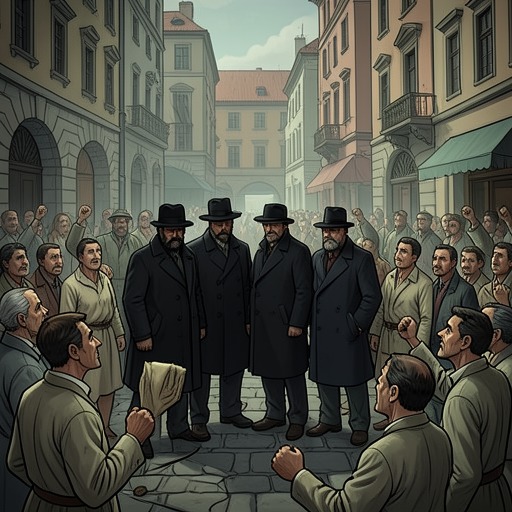
In Milan on April 15, 1919, Marinetti addresses a mixed crowd gathered around the equestrian monument to Vittorio Emanuele II. His Futurist manifesto calls for the destruction of museums, libraries, and academies, and celebrates militarism, patriotism, and war. Its language joins cultural revolt to political violence: destruction is not merely an end, but an imagined cleansing of a world he considers exhausted. The expression War, the world’s only hygiene condenses that proposition into a slogan.
The book sets the slogan beside Marinetti’s experience of the war he had praised. He enlisted in the Alpines, was wounded, returned to the front, experienced defeat at Caporetto, and later drove an armored car at Vittorio Veneto. In 1919, he climbed down from the monument and urged bystanders to join the counter-demonstration, rejecting neutrality. The confrontation that followed made the political stakes of his rhetoric immediate: socialist marchers faced officers, Arditi, and Futurists across a cordon of carabinieri, and the encounter escalated into gunfire.
The Aftermath the Slogan Cannot Cleanse
The postwar world presented in the book is not hygienically renewed. It is submerged beneath the dead of the trenches, while millions of veterans return to a continent described as a stage without its former actors. The narrator sees the old political class as spent and the returning soldiers as a mass that will reshape the future; yet the passage also insists that the fighting is not over. The contrast is central to the expression’s force: the promise of purification arises from a landscape saturated with the consequences of war.
Marinetti’s rhetoric also belongs to a broader postwar language of rupture. In his New Year address to his legionnaires, Gabriele D’Annunzio opposes Fiume’s youth, light, and heroic life to the exhausted world of the Versailles negotiations. He chooses to remain in Fiume despite the wishes of its inhabitants, while the narrator observes that Italians have not followed him and that his authority as a prophet of youth is already fading. The vision of renewal therefore appears as a political claim, not an accomplished transformation.
From Violence to National Rebirth
When the National Fascist Party is founded, Benito Mussolini presents Fascism as a synthesis capable of absorbing liberalism after violence has buried earlier methods. His program links national unity to the removal of regional identities, invokes an imperial future, and declares that the Fascists are the state. It also presents the masses as requiring an interpreter who will serve and educate them, while the nation’s future is tied to the health of its bloodline. In this program, the logic compressed by Marinetti’s expression becomes part of an expansive political project: violence is associated with remaking the nation, not simply with revolt against cultural institutions.
The book later portrays Mussolini as the figure through whom that promised rebirth is personified. His public image sets youth against the old political order and presents him as a force able to master chaos and restore safety. The claim that he can create a desert and call it peace exposes the tension inside this image: order is represented as the result of violence, while the devastation that makes such order possible recedes from view. At a later commemoration in Piazza Belgioioso, Mussolini contrasts the movement’s former handful of adherents with its present multitude and describes its revival in religious terms, linking the crowd’s enthusiasm to a people becoming a nation and a state.
The Dead as Counter-Memory
The cult surrounding the Unknown Soldier gives collective death a solemn national form. The chosen body represents the fallen as a whole, and the coffin becomes an altar for a war in which killing has become mechanical and death impersonal. Fascist founders kneel before it in Rome, while the book draws attention to the religious character of the political ceremony. The ritual does not erase the dead; it makes their anonymity the basis of a public symbol.
The second burial of Giacomo Matteotti offers a different kind of memorial scene. On August 21, 1924, his remains are returned to the earth in Fratta Polesine, at the wish of his wife, Velia, who refuses a political burial in Rome. Workers gather along the railway route and in Fratta, where their calls demand vengeance, justice, and liberty. The scene places grief and political demand alongside one another. Against the promise that violence can purify history and deliver a new order, the repeated acts of burial insist on what that promise leaves behind: individual loss, mourning, and unresolved claims for justice.